
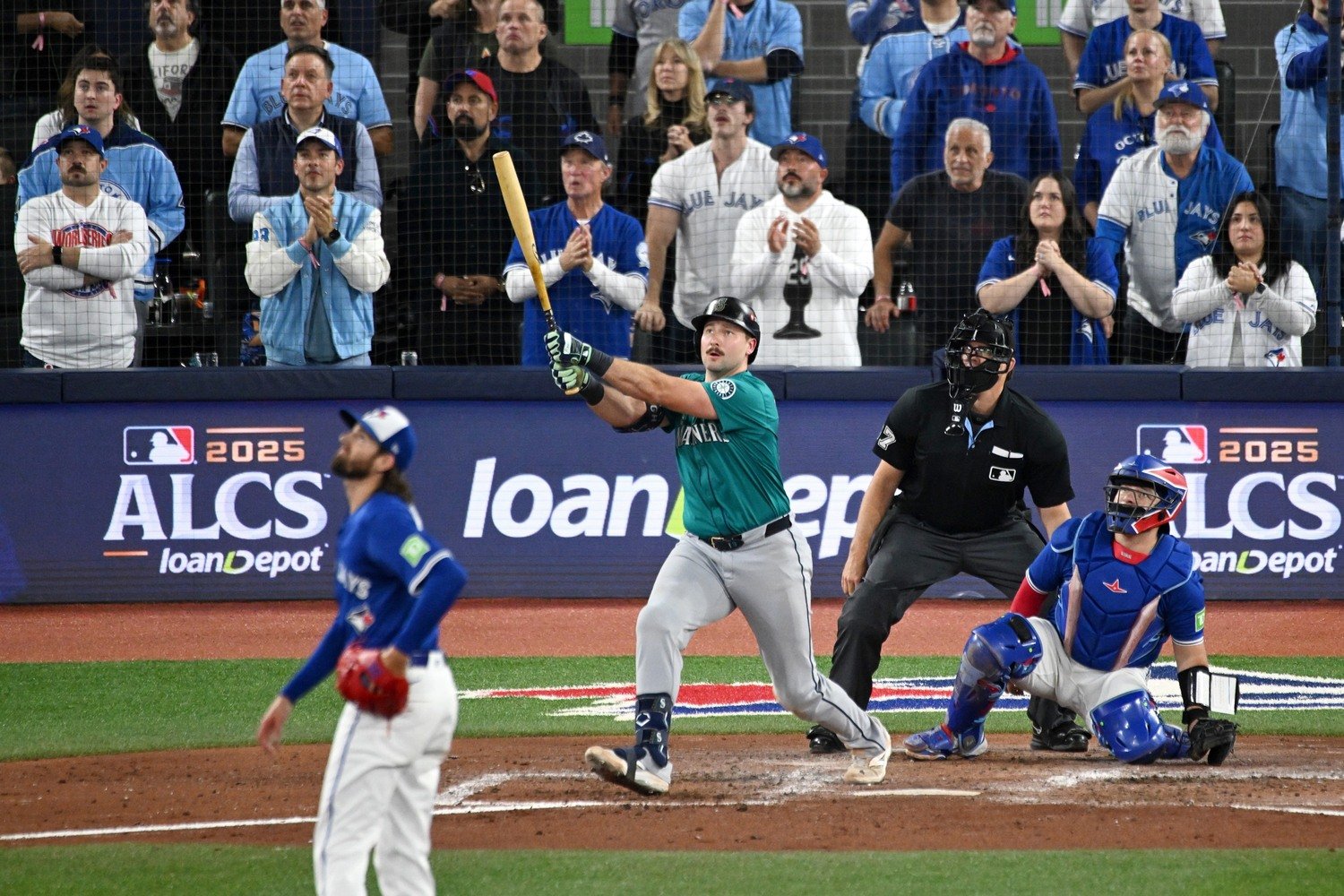
A roaring start, a quiet collapse, and a nation’s October hopes slipping away as the Blue Jays fall 3–1 in a Game 1 that revealed more than the scoreline.
For a moment, it felt like destiny was cracking its knuckles. Game 1 of the ALCS opened with the kind of energy Toronto hasn’t tasted in decades — not the polite, corporate optimism of a mid-season Sunday game, but the raw, pulsing, borderline-delusional belief that something miraculous might finally happen again on this patch of concrete beside the Gardiner. The Rogers Centre wasn’t just loud. It was vibrating. People weren’t merely watching baseball. They were participating in a national ritual of hope, doubt, and inherited trauma.
And two pitches into the bottom of the first, that ritual briefly became scripture.
At 8:04 p.m. EDT, the first pitch crossed the plate and 40,000 people convulsed in anticipation. You could feel the ghosts before you saw the scoreboard: 1992, 1993, Joe Carter frozen mid-leap in the collective memory of a country that hasn’t had much to cheer about since. This wasn’t just a baseball game. It was a séance disguised as a sports event. Then George Springer — the closest thing the modern Jays have to a postseason talisman — stepped up, saw a fastball up in the zone, and uncorked a swing so clean it felt mythological. The ball carried to right, cleared the wall, and suddenly the Blue Jays led 1–0.
Across the country, the same text lit up thousands of phones: WE’RE BACK BABY.
Canadians don’t allow themselves this kind of optimism often. It’s reserved for hockey prospects, the occasional economic forecast, and the Blue Jays in October. For ten sublime minutes, it felt like the streets of Toronto might spontaneously sprout parade barricades. Bars from Vancouver to Moncton erupted. And then, as always, reality reintroduced itself.
The rest of the first inning should have been a warning. Nathan Lukes walked, Addison Barger walked, and with one out the Jays had a chance to blow the game open. But Guerrero and Kirk each made solid contact that died harmlessly in outfield gloves. The crowd didn’t panic — this was still the version of the night where everything seemed destined — but the familiar tension was creeping in at the edges.
Seattle’s Bryce Miller, momentarily rattled by Springer’s blast, recomposed himself with unsettling speed. By the third inning he was slicing through the Blue Jays’ lineup like he’d been born inside a quiet room. Groundouts, soft fly balls, polite pop-ups — Toronto’s hitters spent the middle innings looking like they were trying to remember how bats worked.
On the other side, Kevin Gausman looked like the ace Toronto has been begging him to become in October. His splitter snapped hard, his fastball ticked upward, and through five innings he looked capable of pitching Toronto to a kind of redemption arc.
Baseball, however, is the most patient villain in sports. It waits for a crack. And in the sixth inning, it found one.
Two outs. Nobody on. Gausman ahead in the count. Cal Raleigh at the plate. Raleigh — a man who looks like he was built from driftwood and strong opinions — got a splitter that hung a hair too long. It floated, he punished it, and the ball soared over the wall in right-center. 1–1. The stadium didn’t gasp; it sighed. A long, involuntary sigh that every Jays fan could feel in their bones.
Moments later came the turn of the knife. Julio Rodríguez walked, advanced on a wild pitch, and Jorge Polanco slapped a clean RBI single to left. Seattle took a 2–1 lead. It wasn’t catastrophic. It wasn’t dramatic. It just… happened. And the game quietly shifted into a story Toronto has told too many times.
From Springer’s home run onward, the Blue Jays recorded only three more hits. None after the fifth inning. None when it mattered. Miller handed the baton to the Mariners’ bullpen — Speier, Brash, Muñoz — and they carved the lineup into polite little pieces. Guerrero grounded out with machine-like consistency. Kirk produced well-intentioned but unhelpful fly balls. Varsho chased. Springer struck out twice. Every inning followed the same bleak pattern: a flicker of hope smothered by routine fielding.
The Jays didn’t collapse — they evaporated.
If the sixth inning broke them, the eighth buried them. Randy Arozarena reached base, immediately stole second, then third, like a man playing a different sport at a different speed. Toronto’s reaction suggested everyone had collectively agreed not to contest the matter. Polanco, now thriving as the evening’s principal antagonist, punched another RBI single. 3–1 Seattle.
The final two innings had the emotional texture of a dental appointment. Toronto’s hitters went down quietly: soft grounder, harmless fly ball, ball-in-glove-no-drama. The crowd didn’t boo. They didn’t rage. They simply… accepted it. Acceptance is one of the great Canadian sports traditions.
The Mariners won 3–1. They played like a team with swagger and opportunism. Toronto played like a team submitting paperwork.
The betting story matched the vibe: Seattle cashed as a +135 underdog, the run line was never remotely threatened, and the under 7.5 coasted without suspense. Gausman pitched well enough to win; the lineup ensured he didn’t. The Jays now trail the ALCS 0–1, and while nothing is over, the margin for error already feels razor-thin.
This is the thing about the Blue Jays: they carry an entire country’s baseball identity on their backs. Since the Expos vanished, the Jays became a national project — a cultural export, a unifying symbol, a reason for sports bars in Saskatchewan to show baseball in October. But they also inherited every insecurity that comes with representing Canada on an American stage. They are competent, respectable, well-run, and almost always unable to seize the moment when the moment screams for it.
Their failures aren’t dramatic meltdowns. They’re slow fade-outs. They don’t crash — they sigh.
Game 1 didn’t reveal anything new about the Toronto Blue Jays. It simply restated a truth fans already knew but desperately tried to forget for one night: this team can look like a contender in theory and still play like an understudy when the lights hit.
The game began like a dream — Springer channeling the ghosts of ’93, a country roaring back to life — and ended like a shrug. Fans shuffled out politely, packing away their yearly ration of belief. Toronto will try again tomorrow. They always do. And that’s the thing about hope in this country: there’s always more of it, even when the innings run out.
ALCS Game 1: Mariners 3, Blue Jays 1. A polite reminder that dreams have limits, and Toronto met theirs somewhere between the first inning and the final out.