
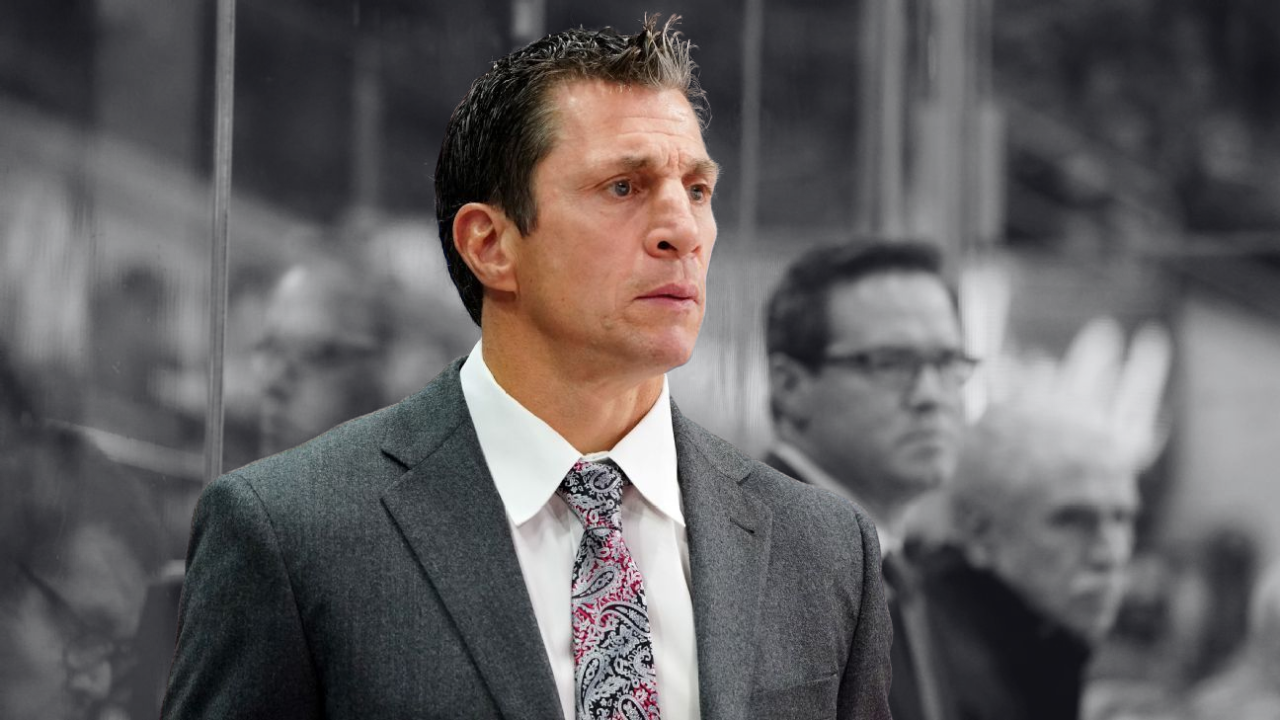
Carolina’s coaching stability keeps them competitive, but lingering goaltending issues continue to hold back a roster built on structure, pressure, and control.
In a league where coaching turnover is practically a seasonal ritual, the Carolina Hurricanes have built something increasingly rare: genuine stability. That stability has a name—Rod Brind’Amour—and his presence has shaped the Hurricanes into one of the most consistently competitive teams in the NHL. But even with a decade of organizational integration and a coaching reign that began in 2018, the Hurricanes continue to wrestle with one stubborn, lingering flaw: goaltending.
It’s a strange contradiction. Carolina is one of the smartest, best-coached, most structurally sound teams in hockey. They drive play, dominate shot share, and lock opponents into their own end for entire shifts. Yet every postseason, fans and analysts return to the same question: Is this the year the Hurricanes finally get the goaltending they need? So far, the answer remains elusive.
Brind’Amour: The Franchise’s North Star
Rod Brind’Amour is more than a coach in Carolina—he’s practically an institution. Long before he stepped behind the bench in 2018, he’d already spent years embedded in the Hurricanes’ identity. He joined the organization’s staff in 2011, not long after retiring, and quickly became the connective tissue between the franchise’s past and its future. His tenure spans eras, rosters, and front-office reshuffles. He has become the stable variable in an ever-shifting equation.
Under Brind’Amour, the Hurricanes have transformed into one of the league’s most disciplined and analytically driven teams. They forecheck relentlessly, they pressure with astonishing consistency, and they maintain a structure that allows them to defend before the puck even leaves the offensive zone. Their brand of “defense in the offensive zone” is not only stylistically distinctive—it’s incredibly effective.
And yet, despite these accomplishments, many fans still experience moments of strange, almost humorous misremembering about Brind’Amour himself. One user recently joked about having a Mandela effect moment when they realized he wasn’t American. It’s a funny detail, but it highlights something deeper: Brind’Amour has been such a constant presence for so long that people rewrite his history in their heads. He simply feels like the face of the modern franchise, regardless of how you remember the details.
A Familiar Problem: The Goaltending Question
What the Hurricanes cannot seem to stabilize, however, is the most volatile position in the sport. Goaltending has been the team’s Achilles’ heel for years—arguably decades. They’ve had strong seasons from individuals, moments where a goalie briefly goes on a tear, and streaks of competence that mask the underlying instability. But Carolina hasn’t had a truly elite, game-stealing presence in net since the peak years of Cam Ward.
Their system is designed to minimize the need for heroics. They allow few high-danger chances, dominate possession, and push opponents to the perimeter. In theory, a team that controls shots and tempo as well as Carolina shouldn’t need a superstar in net. In practice, playoff hockey has a way of punishing teams without one.
Game after game, season after season, the Hurricanes find ways to tilt the ice in their favor but struggle to get the timely saves required to close out series. It’s not that the goaltenders are bad—they’re often perfectly acceptable. But when the margins shrink and pressure intensifies, the gap between “acceptable” and “championship-caliber” becomes massive.
Defense in the Offensive Zone: Carolina’s Calling Card
One of the hallmarks of Brind’Amour’s Hurricanes is their unique approach to defending. Instead of retreating into set structures in their own end, they suffocate teams before the play ever gets that far. Their forecheck isn’t just aggressive—it’s oppressive. Their cycling isn’t just possession—it’s suffocation disguised as offense.
By keeping the puck deep in the offensive zone, they reduce the workload on their goaltenders and increase the predictability of the few chances they allow. It’s smart, modern hockey rooted in analytics and relentless work ethic. But even the most sophisticated system can only reduce—not eliminate—the need for a goalie who can deliver at the biggest moments.
And every season, the Hurricanes run into the same fate: all the territorial dominance in the world can’t erase the impact of one leaky goal, one shaky game, or one series where the goaltending simply isn’t there.
History Repeating Itself: A Brief Detour to 2002
Carolina’s relationship with Toronto adds a small but amusing wrinkle to the broader narrative. In 2002, before the Hurricanes were an analytics darling or model of structural discipline, they shocked the Leafs in the Eastern Conference Final. And while the Hurricanes eventually fell to Detroit in the Stanley Cup Final that year, beating Toronto remains one of the franchise’s more memorable upsets.
What’s funnier is the hypothetical scenario that emerges today: if the modern Hurricanes ever faced the Maple Leafs again in the playoffs and beat them, it would mean Brind’Amour had defeated Toronto both as a player and as a coach in the same playoff round. It would be the kind of poetic, Leafs-infuriating trivia that hockey fans love to repeat.
Stability vs. Instability: The Hurricanes’ Paradox
The Hurricanes may be one of the NHL’s most well-run organizations, but they’re also one of the most predictable in their failures. Everything is stable—except the one thing that matters most in spring. Brind’Amour has created a culture of consistency, effort, and attention to detail. He has built a system that makes average players look good and good players look great. He has turned Carolina into a perennial contender.
And still, the question hangs over every postseason: Can they get the saves?
Until that question is answered with a Stanley Cup, the Hurricanes will continue to live in a strange limbo. They’re too good to dismiss, too flawed to trust, and too consistently brilliant to be anything but one move away from greatness.
If they ever find the goalie who can match Brind’Amour’s stability behind the bench, the Hurricanes won’t just be a threat— they’ll be a dynasty waiting to happen.