
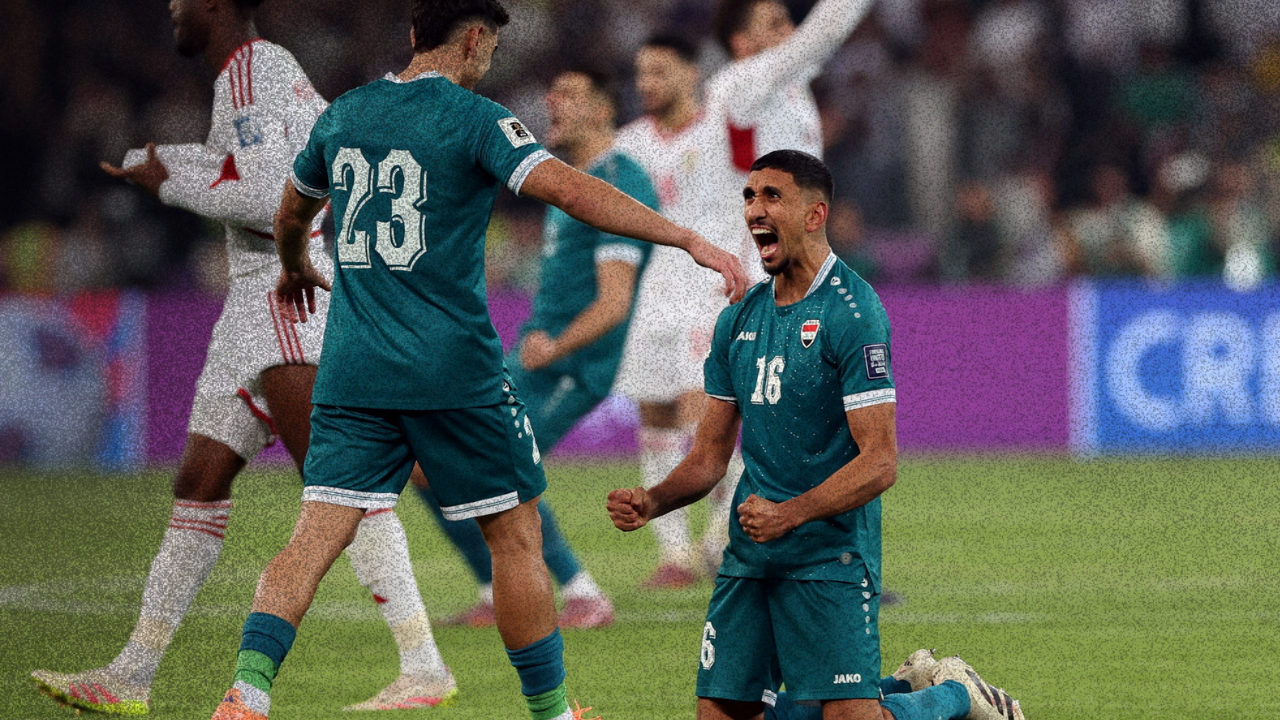
Iraq World Cup 2026 qualification is confirmed — a 2-1 win over Bolivia, the very last spot in the tournament, forty years in the making.
Iraq Are Going to the World Cup
Ali Al-Hamadi headed Iraq in front in the 10th minute. Moisés Paniagua equalized for Bolivia at 38. Aymen Hussein put Iraq back ahead at 53 and that was the result — 2-1, full time, forty years of absence over. Bolivia had 65 percent possession. They had nine corner kicks. They had five shots on goal to Iraq’s three. They dominated the ball for most of ninety minutes and still lost, because Iraq sat deep, defended their lead with composure, and did not crack. At the final whistle, the Lions of Mesopotamia had done what the last forty years of Gulf War, invasion, occupation, and ongoing conflict had made seem structurally impossible: qualified for a World Cup.
Iraq claimed the very last spot in the 2026 World Cup. The last appearance was 1986. Forty years. Everything that has happened to Iraq since then — the Gulf War, the US-led invasion, the dismantling of the state, the internal conflict that followed — unfolded without Iraq at a World Cup. Tonight that changes. They go to Group I with France, Senegal, and Norway. Three nations for whom qualification is structural expectation. One nation that got here through a private jet after commercial flights were grounded by missile strikes in their region.
The Journey Here Was the Story
Coach Graham Arnold was stranded in Fujairah when Iraq’s airspace closed following strikes in the region. The squad could not leave the country on commercial flights. Iraq requested FIFA postpone the match. FIFA declined. A private jet was eventually secured. Arnold spent the days before the match focused on one task — removing all of that from the players’ brains. They did remove it. Ten minutes in, Al-Hamadi’s header said everything about how well they managed it.
Iraq’s national team has functioned across decades of internal fracture as one of the few symbols around which Sunni, Shia, and Kurdish communities rally without division. The 2007 Asian Cup — won at the height of internal conflict — demonstrated exactly what football means in that context. What qualification tonight means extends well past sport. It allows Iraq to project, internally and externally, that the state still functions. That it can organize, travel, compete, and win. That is not just pride. That is legitimacy.
Bolivia and the System That Produced This Match
Bolivia did not deserve to lose on the balance of play. They had the ball. They created more. They came back from behind against Suriname in the semifinal to win 2-1 without their all-time top scorer Marcelo Martins Moreno. They beat Venezuela and Chile to get here. They had not been to a World Cup since 1994. Tonight extends that absence to thirty-two years.
But the result also confirms exactly what the structure of this match was always going to produce. The intercontinental playoff exists to compress peripheral nations into a single elimination funnel. Iraq and Bolivia did not meet the core powers tonight. They met each other. European teams received the largest share of guaranteed World Cup spots in this cycle. South America’s elite powers dominate their region. Meanwhile Asia and CONMEBOL’s lower tier are pushed into routes demanding more games, more risk, and more elimination points — until two of them end up in Monterrey at 11pm on a Tuesday, playing for the last available ticket. One goes through. One goes home. The system is working exactly as designed.
What Iraq Takes Into the Tournament
Iraq go into Group I as underdogs against France, Senegal, and Norway — three nations whose players develop in European leagues, whose infrastructure is stable, and for whom the World Cup is a recurring feature of the football calendar. Iraq’s players largely operate in the Gulf and the Asian leagues. Their qualification process required navigating closed airspace. None of that makes the group impossible, and none of it diminishes what tonight means.
Forty years is a long time. The country that last qualified in 1986 does not exist anymore in the form it took then. What does exist is a national team that held together through all of it, that reached a World Cup through a process designed to exclude them, and that won the match they needed to win under conditions most sporting organizations would have used as grounds to request a postponement. FIFA said no. Iraq said fine. Aymen Hussein scored in the 53rd minute. That is the story.