
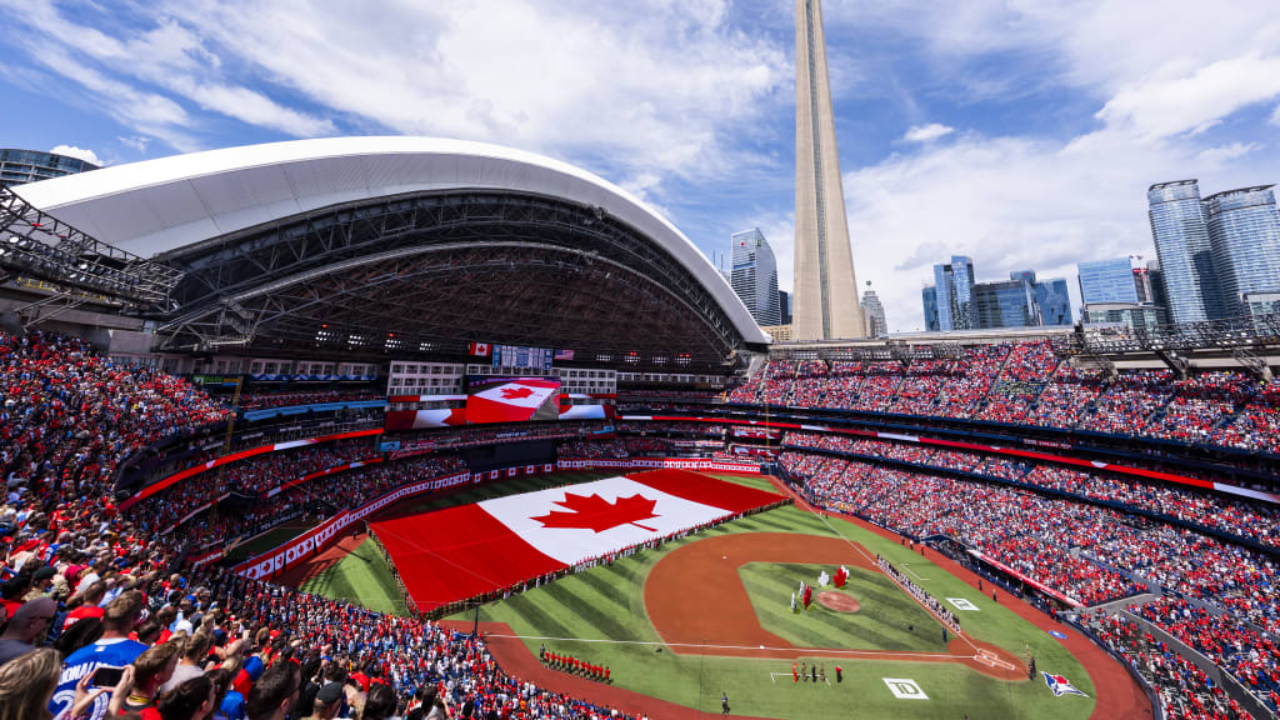
In a multipolar world defined by economic power, Canada is using sports to build cohesion, ease political divides, and consolidate the population for global competition.
One of the simplest truths about the twenty-first century is also the most uncomfortable. Global competition is no longer defined by democratic ideals, military intimidation, or diplomatic rhetoric. It is defined by economic capacity.
The countries that shape the future are not the ones with moral clarity or historical prestige but the ones that can generate, mobilize, and protect wealth at scale.
China is the clearest example of this reality, but it is not the only one. Every state now exists within this economic arena, and every state has to adapt to survive within it.
Canada, a country that has long relied on the United States for political ballast, cultural definition, and economic cover, finds itself navigating a world where America is no longer a stable point of reference.
The American collapse is a long, uneven process, but its signs are clear. Its political institutions are fracturing. Its economy is volatile. Its cultural influence is fading. Its ability to act as a unifying hemispheric power is thinning. And Canada, which has historically defined itself in opposition to or partnership with the United States, now needs a new basis for internal coherence.
This is where sports enters the picture. Not as entertainment. Not as escapism. But as statecraft.
The idea sounds provocative until you dig into it. Canada is increasingly using sports as a mechanism to manufacture national cohesion. Not in a sinister or conspiratorial way but as the natural outcome of overlapping economic interests between the state and corporate institutions. This is not a morality play. It is a structural shift shaped by economic pressures.
To understand the logic, start with the proposition that political division is detrimental to economic development. Markets thrive on stability. Investment thrives on predictability. Countries that fracture into ideological blocs create fragmented markets that cannot scale. In a multipolar world, where countries must operate as coherent economic units to remain competitive, internal cohesion becomes a strategic asset.
Canada’s problem is that its political divisions run deep. Regional, linguistic, cultural, and ideological divides cut across the country in ways that cannot be easily reconciled by political processes. Politics cannot mend these fractures because politics is their cause. Elections harden divisions. Parties benefit from them. Institutions inherit them. There is no democratic mechanism that can unify a population that has been systematically trained to hate one another along partisan lines.
So the state has begun to look elsewhere for tools of cohesion. And sports, being apolitical in presentation but emotional in effect, has become the vehicle.
Sports creates what Benedict Anderson called imagined communities. Regions adopt teams as symbolic extensions of themselves. Fans build identities that transcend ideology. The Leafs are not Liberal or Conservative. The Raptors are not NDP or Bloc. The Jets are not defined by Quebec separatism or Prairie alienation. They are intermediaries, containers for emotional allegiance that smooth over political difference.
This is why sports function as statecraft. The allegiances they cultivate are imagined spaces, built from the top down, that redirect the emotional energy normally captured by political identity into something economically neutral. Instead of defining yourself through a political story that divides you from your neighbors, you define yourself through a team that binds you to them. Instead of channeling rage into electoral warfare, you channel it into a harmless rivalry with a neighboring city. Politics tears apart. Sports sutures.
Canada is not unique in this practice. Every major power uses cultural tools to consolidate identity. But the Canadian case is distinct because its statecraft is not built on national mythology in the traditional sense. It is built on regionalism. This is a country designed around local attachments. The state has always struggled to unify these regions under a single narrative. But sports already does that work organically. The NHL, the CFL, the Raptors, the Blue Jays, and the expanding soccer ecosystem each serve as containers for regional self-definition. They create spaces where people feel a sense of belonging that does not rely on political narratives.
This effect becomes strategic in a multipolar world. Canada needs a consolidated population if it hopes to act as an economic force. The economy requires markets, and markets require populations that are not tearing themselves apart over ideological boundaries. If you want to open as many markets as possible, the emotional architecture of the nation has to be stable. Sports provides that stability.
This is not a claim that Canada is manipulating its citizens. It is not an endorsement or a condemnation. It is an observation that economic forces push the state and the corporate world toward convergence. Politicians and business leaders both benefit from a population that is cohesive, predictable, and emotionally manageable. Sports provides an apolitical avenue for achieving that. It is statecraft because it creates the emotional preconditions for economic functioning.
The deeper point is that individuals are part of these systems whether they want to be or not. You cannot opt out of the structural conditions of global capitalism. You cannot opt out of the incentives that governments respond to. You cannot opt out of the cultural formations that markets require to expand. Whether you are a Marxist, a conservative, a liberal, or politically detached, you still live inside an economy that demands certain forms of cohesion. The state, the market, and the cultural industries all respond to these pressures.
This perspective is striking because it does not moralize and it does not rely on any shadowy conspiracy. It describes a structural shift that emerges naturally from material conditions. Canada’s use of sports as statecraft is not about propaganda. It is about economic survival, about preparing the population for a world where national endurance depends on economic competitiveness rather than military alliances or moral narratives.
As the world moves deeper into multipolarity, the pressure to create internal cohesion will only intensify. Countries that cannot consolidate themselves will fracture. Countries that fracture will stagnate. And countries that stagnate will become economic dependents of those that do not.
Sports does not solve every problem. It does not erase inequality, regional alienation, or political discontent. But it does offer a cultural bridge that can redirect emotional energies in ways that serve the broader economic goals of the state. It provides a common language, a set of shared experiences, and a set of regional attachments that can be harmonized into national coherence.
The question is not whether this is good or bad. The question is whether this is the new reality of a world where economic power is the only form of power that truly matters. And in that world, sports is not just a pastime. It is a structural tool. It is a way of creating the emotional conditions that allow a country like Canada to function in the emerging global order.
Whether we like it or not, we are all part of this shift. The stadium is a political space now, even if the politics it produces are disguised as loyalty, rivalry, and civic pride. And in a multipolar world defined by economic competition, that might be exactly why it works.