
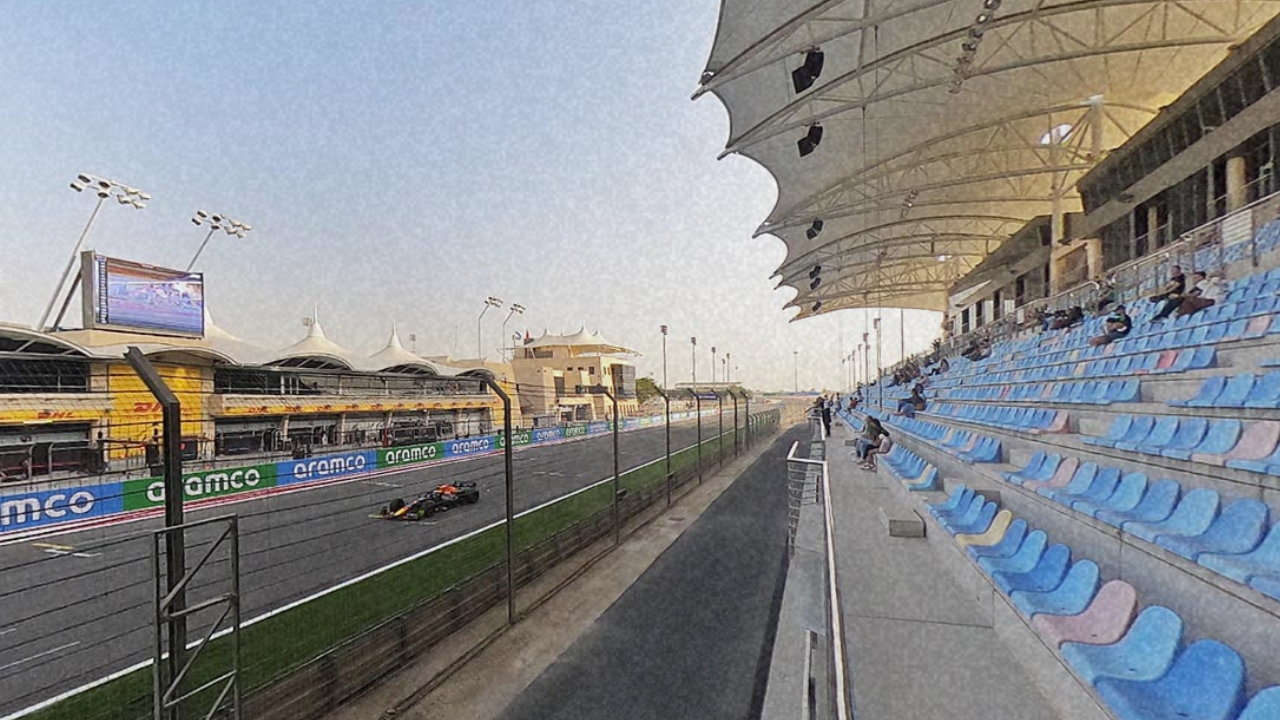
The Bahrain circuit is twenty miles from a US base Iran already hit. F1 had a contract through 2036. The race and the base were always in the same project.
On March 14, Formula 1 and the FIA announced the cancellation of the Bahrain Grand Prix, scheduled for April 12, and the Saudi Arabian Grand Prix, scheduled for April 19. The statement cited safety concerns stemming from the ongoing conflict in the Middle East. Neither race would be replaced. The 2026 season, which had opened in Australia and China, dropped from twenty-four rounds to twenty-two, leaving a five-week gap in the calendar between the Japanese Grand Prix on March 29 and the Miami Grand Prix on May 3.
The official framing was that circumstances had made travel and competition unsafe. That is true and also incomplete. The circumstances did not arrive from outside. They were built into the infrastructure of the events themselves from the start.
The Base Twenty Miles Away
Naval Support Activity Bahrain, headquarters of the US Fifth Fleet, sits in Juffair, a district of Manama popular with the F1 paddock during the Bahrain race weekend. The base is roughly twenty miles from the Bahrain International Circuit at Sakhir. Iran struck that facility in the opening days of the war. The strike hit a location where members of the racing paddock typically stay.
Bahrain has hosted the Formula 1 season opener or an early-season race since 2004, when it became the first Middle Eastern country to join the calendar. By the time the war started, Bahrain had already extended its contract with Formula 1 through 2036. The hosting fee for a Grand Prix averages around thirty million dollars per race. Those fees are sunk costs — they do not come back when the race is cancelled. The Bahraini government paid them as part of a decades-long strategy to position the country as a stable, globally connected destination for business, tourism and capital.
The US military base is part of the same strategy. Bahrain hosts the Fifth Fleet because the arrangement signals to the world that the country is aligned with Western security architecture — which, in turn, signals that it is safe for investment and international events. The racing contract and the basing agreement are expressions of the same political project. When Iran targeted the base, it was targeting that project. The race became untenable not because war arrived from outside but because the war reached the infrastructure the race was built on top of.
What the Analysts Say Without Saying It
The Center for Strategic and International Studies published an analysis of the cancellations on July 9, written by Emily Harding, vice president of CSIS’s Defense and Security department, and Cynthia Cook, a senior fellow there. It is worth reading carefully, because it names the function F1 was performing in the Gulf without appearing to notice what that naming implies.
The CSIS piece describes F1 as a highly visible platform embedded in national economic and geopolitical strategies, and says hosting Grand Prix races helps Gulf states position themselves as stable, modern hubs for tourism, investment, and international engagement. It notes that Iran could threaten marquee international events as a low-cost coercive strategy — using the threat of attack to signal that Gulf states’ economic diversification depends on a stability that the US-Iran conflict has put at risk, and thereby generating pressure on Washington toward de-escalation.
That analysis is accurate. It is also the establishment naming sportswashing in its own vocabulary. A platform embedded in national geopolitical strategies, used to project stability for a state whose stability depends on US military protection, is what critics have been describing for years when they note that Gulf states use sport to launder their international image. The CSIS framing calls this a vulnerability. The less charitable reading is that it was always the design, and the war simply made the design visible.
They Voted to Race Once Before
The 2022 Saudi Arabian Grand Prix provides the contrast. During opening practice at the Jeddah Corniche Circuit, a missile struck an Aramco facility visible from the grandstands. Smoke drifted across the track. Teams held a meeting that evening and voted to continue. The race went ahead on assurances from local security forces that there was no immediate threat to the circuit. Formula 1 pressed on.
In 2026 the calculation was different in every dimension. Iran had struck targets across Bahrain, Kuwait, Qatar, Saudi Arabia and the UAE. The Bahrain base in Juffair had been directly hit. Airspace restrictions across the Gulf had cancelled tens of thousands of flights. The freight required to move eleven teams and their equipment could not be reliably routed. Insurance providers do not pay out in case of war. The logistics deadline for shipping equipment from Japan to the Gulf passed without a viable path. There was no vote to take.
Qatar and Abu Dhabi, the season-ending Gulf rounds, remain under threat. F1’s schedule constraints — the teams’ summer break is protected by regulation, and the calendar runs to the first week of December — leave almost no room to reschedule. Bahrain has been pushing to reinstate its race in October. The sport has confirmed contingency planning for alternative venues if the final Gulf rounds become untenable.
The Weekend Warfighter Problem
Formula 1 sells itself as a technology showcase, a tourism generator, a development platform, a climate transition story and a global entertainment product. In the Gulf it is all of those things and also a piece of the Western-aligned security architecture that underwrites the states hosting it. That function is not incidental to the sponsorship model — it is what makes the hosting fees politically rational for governments that could spend thirty million dollars on other things.
When the security architecture comes under attack, the sport discovers it had been inside the conflict the whole time. The race weekend and the military base are not adjacent by accident. They are both expressions of the same bet: that Gulf integration into the Western economic and security order would produce enough stability to make the investment worthwhile. The war is testing that bet, and the five-week gap in the F1 calendar is what a losing position looks like from the outside.
The CSIS analysts note that Iran would not need to conduct sustained attacks to achieve its effects — intermittent disruption is sufficient to erode confidence and raise insurance costs. That observation applies as well to the sport’s own position. Formula 1 does not need to race in a war zone to be caught in one. It only needs to have built its calendar around states whose stability was always contingent on the outcome of a conflict it had nothing to do with and no way to exit.
Sources
- CSIS — Emily Harding and Cynthia Cook, “Formula 1 on the Front Lines” (July 9, 2026); F1 as geopolitical platform, NSA Bahrain’s location, the coercive logic of threatening marquee events, hosting fee averages, the CSIS risk framework
- Sky Sports — official F1 cancellation announcement (March 14, 2026); Bahrain April 12, Saudi Arabia April 19; calendar reduced to 22 races; five-week gap Japan to Miami
- Motorsport.com — cancellation confirmed ahead of the Chinese Grand Prix; no replacement races; Bahrain circuit location relative to the US base
- PlanetF1 — Iranian missile strike on NSA Bahrain in Juffair; US Fifth Fleet base as a target in the opening days of the war (February 28, 2026)
- The Judge 13 — Qatar and Abu Dhabi under threat; F1 contingency planning for alternative venues for season-ending Gulf rounds (May 2026)
- RaceFans — Bahrain pushing to reschedule October race; obstacles to reinstatement given schedule constraints (July 2026)
- Wikipedia — 2022 Saudi Arabian Grand Prix: Aramco facility missile strike during practice, teams meeting, decision to race on assurances from local security