
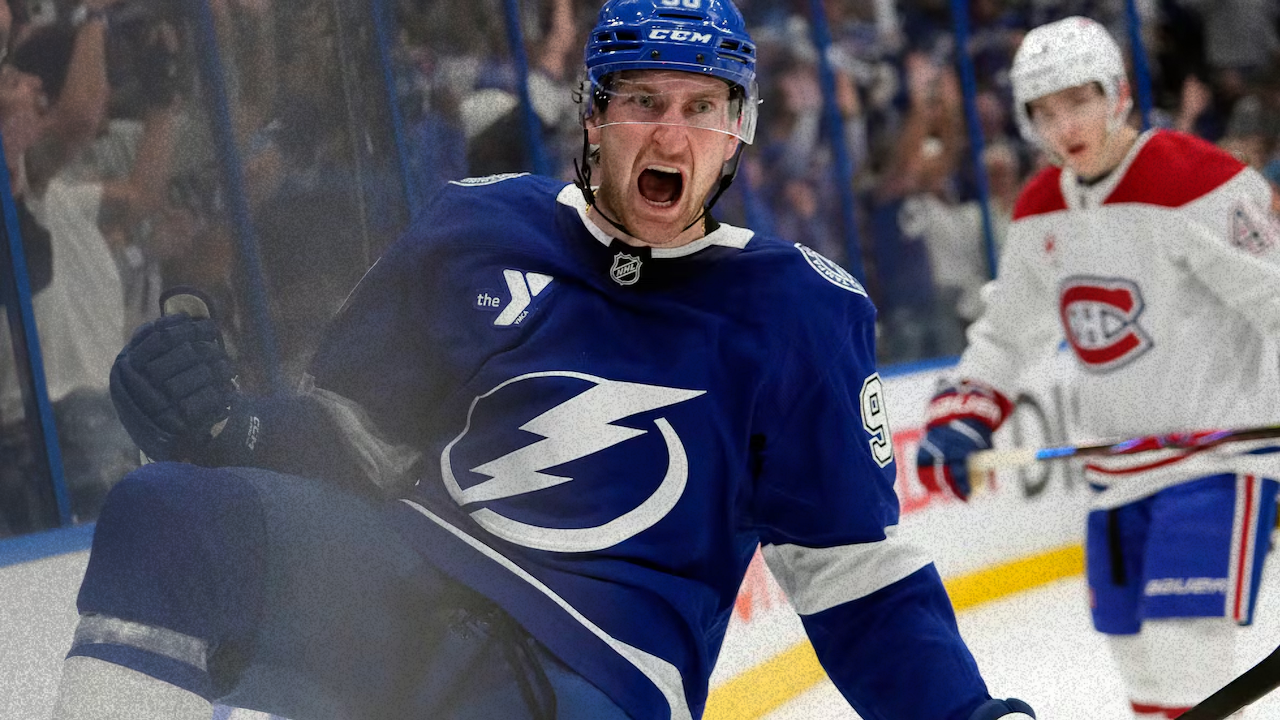
Habs Game 2 in Tampa was a veteran team’s institutional answer: Cooper adjusted the penalty kill, Montreal’s power play stopped converting, series tied.
Tampa came out of Game 1 and rebuilt the kill
Game 2 was 48 hours after Game 1. That is the operational window Tampa Bay had to fix what Slafkovsky did to them on the power play. They used it. The Lightning came out at Amalie Arena on Tuesday night and held Montreal’s man-advantage unit to one goal on four opportunities, a 25% conversion rate down from the 60% the Canadiens posted in Game 1. They did it without sacrificing aggression: Tampa took eleven minor penalties of their own and a major, and still held the line on the penalty kill.
The structural read on the adjustment was visible across the night. Tampa’s penalty kill stopped collapsing to the strong-side shot lane after the first power play and started holding width — the exact answer to Montreal’s overload formation that the Game 1 analysis predicted Tampa would arrive at. The back-door looks Slafkovsky punished in Game 1 were not there. Lane Hutson got six shots through and converted one of them on the power play in the second period, but that was Montreal’s only man-advantage goal of the night. Slafkovsky did not figure in the scoring at all.
Tampa’s own power play also went 0-for-3, which means the special-teams battle on aggregate was a draw in goals despite the radically different opportunity volumes. But the marginal value of Tampa’s adjustment lived in the regulation outcome: if Montreal converts at the Game 1 rate on those same four chances, this is a 4-2 Habs win in three periods and the series goes back to Montreal 2-0. Tampa’s penalty kill was the difference between an institutional crisis and a tied series.
Brandon Hagel is what a veteran roster looks like
Brandon Hagel scored the overtime winner. He also scored Tampa’s first goal of the game, picked up an assist on Kucherov’s even-strength tally, took a five-minute major and a two-minute minor, finished plus-three, and registered five hits. That is the box-score line of a player carrying his team through the most important game of the series so far. Hagel was acquired by Tampa in 2022 specifically to be the kind of depth winger who eats minutes, plays heavy, and produces in playoff hockey. Game 2 was exactly that.
Kucherov’s first-period goal got Tampa on the board, and Hagel’s overtime winner sent them home with the series tied. In between, the Lightning controlled enough of the territorial battle to make the difference. Tampa won 52% of faceoffs against the team that had crushed them at the dot in Game 1. They generated 34 shots to Montreal’s 27. They blocked 15 shots and threw 34 hits. The reformation was complete.
Andrei Vasilevskiy stopped 25 of 27 and earned Second Star. He gave up the Hutson power-play goal and a second Montreal tally and otherwise was the wall he is paid to be. Tampa’s veteran goaltender bouncing back after a Game 1 in which he surrendered four on nineteen shots is the kind of institutional response that separates a team that wins this series from a team that gives back a 1-0 advantage in 48 hours.
Tampa took back the faceoff edge they lost in Game 1
Nick Suzuki won 71% of his faceoffs in Game 1. In Game 2 he won 41.9%, taking 31 draws and losing 18 of them. That is the single largest game-over-game regression in a key territorial stat from anyone in the series so far, and it explains a lot about why Montreal struggled to set up the structural overload that produced three power-play goals in the opener. Tampa centermen — Nick Paul in particular at 72.7%, Jake Guentzel at 71.4% — were prepared for Suzuki’s tendencies. The video was watched. The grip was tightened.
That is what a veteran organization does. Montreal won’t see the same Tampa team that came out flat in Game 1. They will see a team that has identified the specific tendencies and grip points of the young Habs unit and has built an answer for each one. Suzuki’s faceoffs were the first thing Tampa took back. The power play geometry was the second. The territorial battle was the third. By the time overtime arrived, Tampa was operating from a fully reconstructed game plan and Montreal was reacting.
The optimistic read for Montreal is that Jakub Dobes was the Third Star — he stopped 31 of 34 and kept the Canadiens in a game they were being structurally outplayed in. The young goaltender carrying a young team through a Game 2 loss is its own form of development. The pessimistic read is that the rest of the lineup got out-veteran-ed in 48 hours and the series is now tied with home ice already split.
What Montreal has to fix before Game 3
The Habs go back to the Bell Centre with the series at 1-1 and the operational question now reversed. In Game 1 the question was whether Montreal could execute against a Tampa team that hadn’t seen them yet. In Game 3 the question is whether Montreal has its own next answer ready for a Tampa team that has now built a counter. Slafkovsky needs to do more from even strength than he did from the power play in Game 2. Suzuki needs the faceoff edge back. The defensive zone exits that Tampa pressured all night need to clean up.
Hutson’s six-shot night from the back end is the structural piece of good news. The young defenseman generated more shots from the point than anyone else in the lineup and converted one on the power play. He is not the problem. The problem is that the offensive system that depended on Slafkovsky’s third-overload role producing back-door looks is now defended for. Montreal needs the next layer of the system to show up.
That is what a young team learns in a playoff series against a veteran roster. The first game is the original. The second game is the institutional answer. The third game is whether you have your own answer to their answer ready. Series are won by teams that keep generating new layers. They are lost by teams that run out of them.
Game 3 is Friday at the Bell Centre. The crowd will be a structural variable. The system has to do the rest.