
As Israel wages genocide in Gaza, the 2026 Games expose how sport rewards power, silences victims, and collapses when crowds refuse consent.
The Olympic Games are built around a promise that has always been more aspirational than true. For a few weeks, politics are supposed to pause. Nations enter a stadium as equals.
Athletes are framed as individuals rather than representatives of power, violence, or empire. This story has never reflected reality, but for decades it functioned well enough to maintain the appearance of consensus.
The 2026 Winter Olympics mark a turning point. What is collapsing is not simply the idea of neutrality, but the authority of the institutions that rely on it.
The Olympics still confer legitimacy, but they can no longer guarantee acceptance. The ceremonies continue as designed. Flags are raised. Anthems are played. What is missing is the quiet compliance these rituals depend on. The crowd is no longer willing to supply it.
The boos heard during the opening ceremony were not politics intruding into sport. They were the sound of an audience rejecting a script that no longer aligns with what is visible, documented, and ongoing.
Proof That Sport Enforces Power
The treatment of Russia and Belarus remains the clearest evidence that international sport is fully capable of decisive political action. Following Russia’s invasion of Ukraine in 2022, sporting bodies moved with speed and coordination.
National teams were banned. Olympic committees were suspended. Flags and anthems were removed. Athletes were allowed to compete only under neutral status, stripped of national symbolism and excluded from opening ceremonies.
These measures were framed as an unfortunate but necessary defense of sporting integrity and athlete safety. Whether one agrees with them is irrelevant. What matters is that sport demonstrated its capacity to punish states, withdraw legitimacy, and enforce geopolitical norms when political alignment demanded it.
The neutral athlete framework made this explicit. Neutrality was not hesitation or moral uncertainty. It was a calibrated sanction. Competition could continue, but national recognition could not. That distinction established a benchmark that cannot be ignored.
Israel’s Inclusion and the Refusal of Normalization
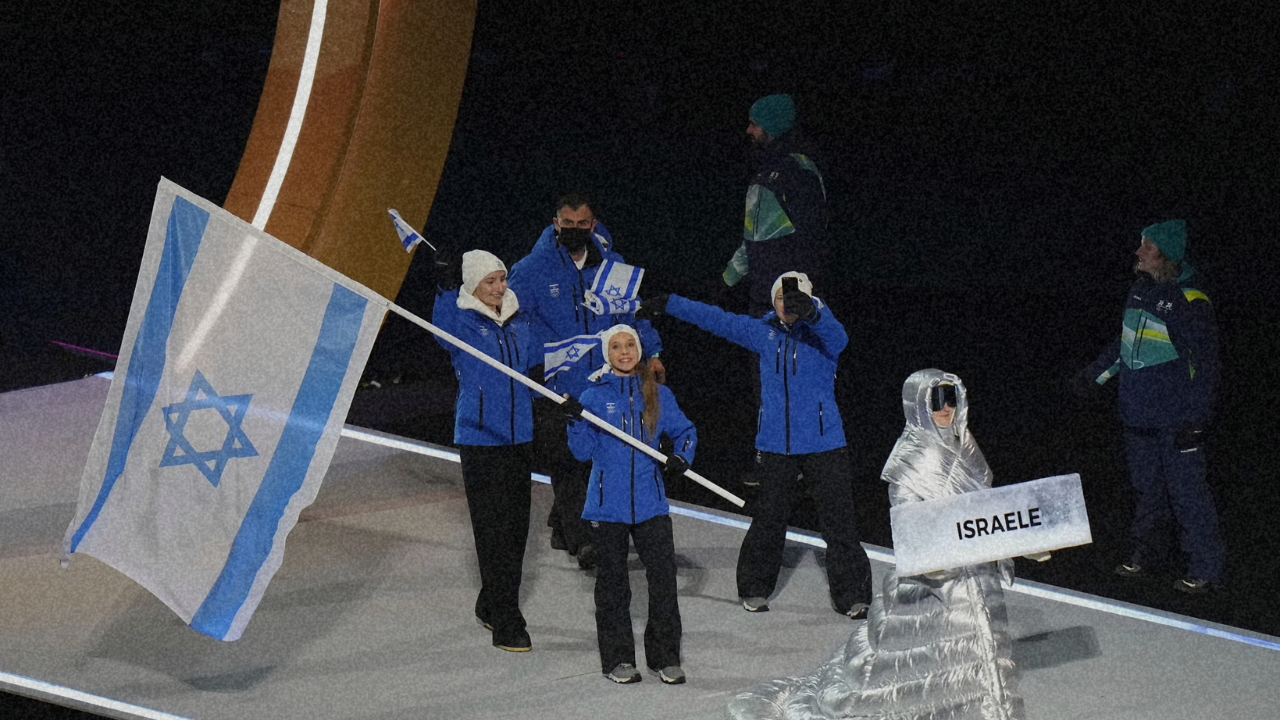
Against that benchmark, Israel’s full participation in the 2026 Winter Olympics is not incidental. It is an intentional institutional decision. Israeli athletes entered the opening ceremony under their national flag. Their anthem was played. Broadcast coverage treated their presence as routine, even celebratory, granting Israel the full symbolic legitimacy the Olympic stage is designed to provide.
This normalization is occurring alongside Israel’s ongoing genocidal campaign in Gaza. Since October 2023, Israel has carried out sustained aerial bombardment and ground assaults that have killed tens of thousands of Palestinians, the majority of them civilians, including thousands of children.
Entire cities have been reduced to rubble. Hospitals and clinics have been repeatedly struck or rendered nonfunctional. Schools, refugee camps, bakeries, water systems, and electrical infrastructure have been systematically destroyed.
Journalists and their families have been killed at rates without modern precedent. Aid convoys have been bombed, border crossings sealed, and food, fuel, and medicine deliberately restricted, producing famine conditions acknowledged by international relief agencies.
These actions have not been hidden or accidental. Israeli political and military leaders have publicly described policies of collective punishment, forced displacement, and permanent territorial transformation.
International legal bodies, including proceedings before the International Court of Justice, alongside reports from United Nations agencies and human rights organizations, have documented patterns of conduct consistent with genocide under international law. What was once dismissed as allegation is now the subject of formal legal adjudication.
None of this has resulted in sporting consequences. Israel has not been suspended from international competition. Its Olympic committee remains in good standing. Its athletes have not been forced into neutral status. Its flag and anthem remain untouched.
The contrast with Russia, which was rapidly sanctioned and symbolically erased from the Olympic stage, is stark and increasingly indefensible. What is being enforced here is not principle, but alignment.
Erasure of Palestinian Sport as Material Reality
The absence of Palestinians from international winter sport is not symbolic. It is the direct result of destruction. Stadiums, training facilities, youth academies, and community sports spaces across Gaza have been systematically obliterated.
Hundreds of athletes have been killed.
Organized competition has ceased to exist.
Sport is infrastructure. It is one of the few remaining avenues through which a besieged population can appear internationally as something other than victims. When that infrastructure is destroyed, futures are foreclosed and visibility is denied.
Palestinians are not absent from the Olympic stage due to a lack of talent or ambition. They are absent because the material conditions required for winter sports have been deliberately eliminated.
When Israel participates normally while Palestinian sporting life has been erased, the Olympics do not stand above the conflict. They function as a mechanism for normalizing it.
The IOC’s Neutrality and Its Selective Application
The International Olympic Committee defends these outcomes by invoking its charter. Sport, it insists, must not be politicized. States are sanctioned only when Olympic rules are violated. On paper, this position appears principled. In practice, it is selective enforcement disguised as restraint.
If the IOC truly avoided politics, Russia would not have been sanctioned as swiftly or comprehensively as it was. Belarus would not remain excluded. Neutral athlete frameworks would not be applied unevenly. The IOC does not operate outside geopolitics. It manages them in accordance with dominant power.
Neutrality in this context does not mean impartiality. It means refusing to act when action would threaten sponsors, broadcasters, or powerful state allies. Violence becomes irrelevant unless it disrupts institutional stability. This is not moral neutrality. It is administrative convenience.
When the Crowd Withdraws Consent
What distinguishes the 2026 Games is not merely institutional hypocrisy, but the public refusal to accept it. The boos directed at Israel during the opening ceremony were loud, sustained, and widely echoed online. They were not aimed at individual athletes. They were directed at what their national representation now signifies.
Opening ceremonies are designed to manufacture consensus. They are rituals of belonging. When a delegation enters to applause, legitimacy is reaffirmed. When it enters to boos, that legitimacy fractures in real time.
This reaction is not isolated. Similar responses occurred at the 2024 Paris Olympics and countless other international events. The repetition matters. It indicates that neutrality is no longer persuading audiences asked to ignore visible, ongoing destruction.
From Israel to the United States
What makes the expansion of boos to include the United States so significant is that, until very recently, this reaction was largely unthinkable. Even in earlier moments of mass protest, including at the 2024 Olympics in France, the residual prestige and cultural authority of the United States functioned as a kind of insulation. Audiences were more than capable of recognizing American complicity in the same systems of violence and impunity, but the symbolic weight of the United States as a global power still carried enough allure to blunt open rejection.
That insulation has now collapsed. What unfolded in Milan was not a sudden awakening, but the visible end of a long erosion. The crowd did not suddenly become more informed than its predecessors. What changed was that the prestige itself no longer worked. The aura that once rendered the United States effectively boo-proof has faded with startling speed, and once that aura breaks, it does not regenerate. Legitimacy of that kind depends on belief, and belief is not recoverable once it has been publicly withdrawn.
When it becomes acceptable to boo a state on the Olympic stage, especially one that once defined the terms of global respectability, the shift is irreversible. This is the same threshold Israel has crossed.
These are not transient moments of protest.
They are signals that a state has entered a category reserved for regimes widely understood as perpetrators and enablers of mass atrocity. There is no reputational rehabilitation from that position.
The United States is not a neutral participant in this process. It is the central guarantor of the global order that enables selective enforcement, shields allied states from consequence, and defines which forms of violence are tolerated.
Booing U.S. representatives alongside Israel reflects an understanding that legitimacy is being distributed through power rather than principle, and that the power itself is no longer commanding deference.
This is why attempts to dismiss the reaction as irrational hostility or prejudice fail. The target is not identity or nationality. It is empire. And once empire becomes audible as something that can be rejected in public, on a stage built to affirm it, there is no return to the old silence.
Boycotts, and the Logic of Exclusion
The Olympics keep telling everyone to calm down and be respectful, but they refuse to deal with the underlying problem. So instead of asking why a delegation is being booed by an entire stadium, the institutions focus on policing the reaction. Booing becomes the issue because banning or suspending anyone has been taken completely off the table.
The boycott talk comes from the same place, and it’s not new or unhinged. We’ve been here before. During apartheid South Africa, cutting a country out of international sport mattered precisely because it shattered the idea that things were normal. It wasn’t about punishing individual athletes. It was about refusing to let a state carry on collecting prestige and applause while enforcing domination and violence elsewhere.
That’s why the boos, the ironic sarcasm by anyone with half a clue, and the boycott calls keep popping up. They’re not people being dramatic for fun. They’re what happens when institutions won’t act. When official bodies refuse to draw lines, the crowd ends up doing it for them, loudly and in public.
The Olympics as a Legitimacy Crisis
The Olympics continue to function as a reward system for acceptable states. What they no longer reliably produce is belief. Institutions can enforce rules. They can stage ceremonies. What they cannot guarantee anymore is consent.
The boos are not the scandal. They are the verdict. They signal that the myth of neutrality is no longer holding under the weight of visible violence and selective enforcement.
Sport was never above politics. It was one of the few remaining places where power could still pretend to be innocent. That pretense is now failing in public. The question is not whether the Olympics will become political. They already are. The question is whether their institutions can survive the loss of the illusion that once protected them.