
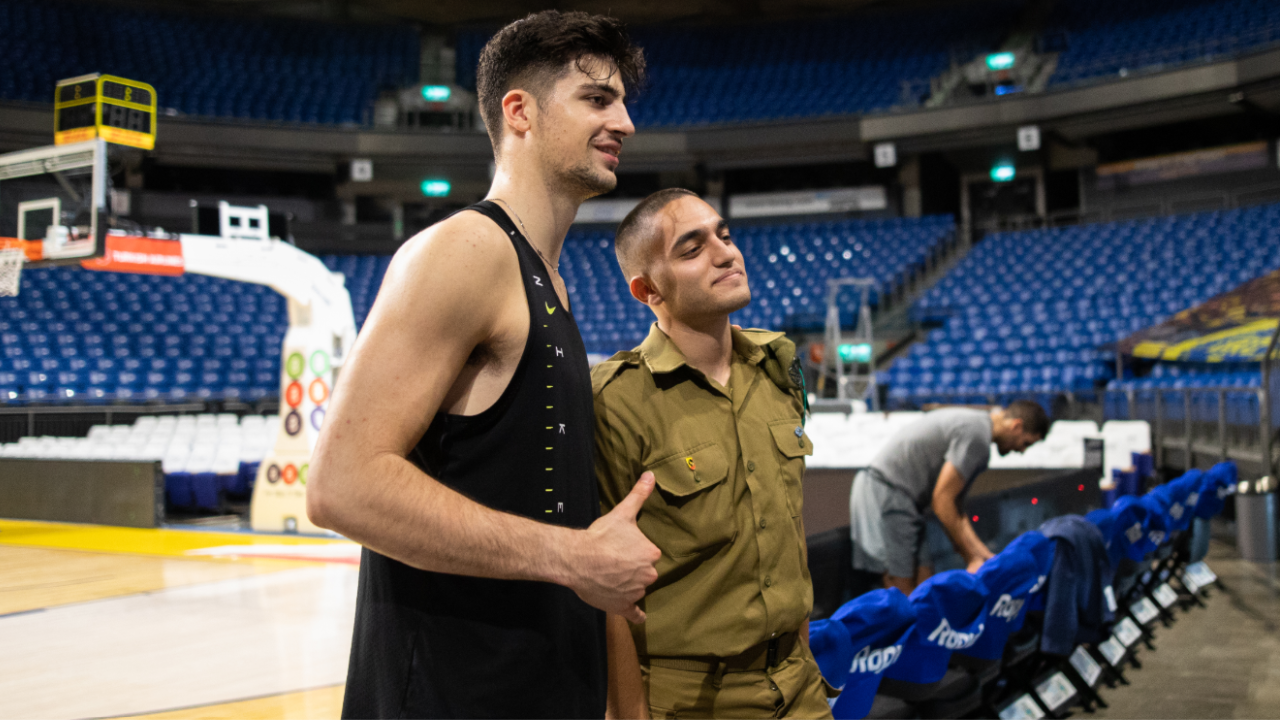
The public backlash towards Israeli NBA player Deni Avdija isn’t about his ethnicity or his birthplace — it’s about his public role in Zionism’s soft-power strategy in the broader context of colonial occupation, state violence, and an ongoing genocide.
The Toronto Raptors edged out a 121–118 win at Scotiabank Arena — a result that mattered far more than the noise around Deni Avdija.
The Israeli-Serbian guard piled up 25 points, 14 assists and eight rebounds, but most of it came in scramble situations that never shifted Toronto’s defense or momentum.
The Raptors controlled the key moments, and Portland left with the loss.
What happened beyond stats on that night in Toronto shows something deeper: a visible effort to turn basketball into political theater.
StandWithUs Canada, a pro-Israel advocacy organization, promoted the night on its public Facebook page and Instagram, inviting the community to attend the game specifically to support Avdija as an Israeli player.
These posts made very clear that the game was being framed as a “community night” for Israel’s supporters.
So when people insist that criticism of Avdija is “real racism,” or that bringing up Zionism and the IDF is irrelevant because “it’s just basketball,” what they’re really doing is asking us to ignore what is plainly happening: Israel-aligned groups were the ones politicizing the evening long before any fan said a word.
Not About Where Avdija Was Born
The claim that criticizing Avdija must be racism because of his Israeli origin is flawed in multiple ways. First, Avdija isn’t being critiqued simply for having been born in Israel.
He’s being held accountable for a public choice: aligning himself with a state and a military force engaged in occupation and repeated violence. That’s a political alignment, not an identity trait.
Second, equating anti-Zionism or anti-IDF critique with racism collapses ethnicity, nationality, politics and morality — a conflation that benefits a certain political agenda.
The demand to treat a player as apolitical because of his nationality ignores his own public self-presentation as a Zionist and as a supporter of the state’s military apparatus.
Third, the “victimhood” narrative gets inverted in this framing: the Palestinian civilians under bombardment and siege become invisible while the NBA athlete — backed by a powerful international promotional machine — gets cast as the oppressed party whenever someone challenges the politics behind his platform.
Deni Avdija Is Not a Neutral Athlete
To treat Avdija as “just a basketball player” is to ignore how deeply entangled he is in Israel’s soft-power strategy.
A profile in The Daily Trojan, the University of Southern California newspaper, reported that Avdija was drafted into the Israel Defense Forces in 2019 and quoted him directly saying that serving in the IDF was “super important” to him.
That same article described him writing “Am Yisrael Chai” and the names of Israeli soldiers on his shoes, and sharing social media posts that ended with the phrase “Israel’s defense is paramount.”
A feature in The Times of Israel goes even further, calling him “probably the number one ambassador we have in global sports and in America,” and quoting a representative saying he “has a responsibility as an NBA player to support Israel and Deni does that very well.”
You don’t get much clearer than that.
His Instagram posts, as documented in that same Daily Trojan article, frequently reference educating Americans about Israel’s perspective and expressing pride in Israel’s military actions.
He is not subtle about his allegiances, nor does he try to be.
So yes: it is a fact, not an interpretation, that Avdija has chosen to frame himself as a public representative of Zionist politics.
Sports Often Weaponized for Statecraft
The idea that Israel uses sports as a diplomatic tool is not a conspiracy. It is mainstream academic research.
A full academic study by Yoav Dubinsky, titled Israel’s Use of Sports for Nation Branding and Public Diplomacy, was published through the University of Tennessee.
Dubinsky’s work demonstrates that Israeli state institutions explicitly use sporting success and global athletic visibility to improve Israel’s image abroad, reduce political stigma, and build soft power.
A policy report by the international think tank IRIS France, titled Sport-Tech Diplomacy: The Case of Israel, explains how Israel uses sports and sports-technology to counter negative associations related to occupation and conflict — specifically to “bypass” political stigma through cultural diplomacy.
Journalism has also long recognized this strategy. A piece in The Guardian, discussing Israel’s sportswashing practices, argues that Israel’s participation in global sports often functions to “launder” its reputation.
So when Avdija becomes Israel’s smiling NBA representative, it fits perfectly into a state-level strategy documented by scholars, think tanks, and journalists across multiple continents.
Why “It’s Just Basketball” Isn’t Neutral
While Israel elevates Avdija as a global symbol, Palestinian athletes are being erased — literally.
The Link reported that Israel’s bombardment destroyed stadiums and training grounds and killed 808 Palestinian athletes and coaches after October 7, 2023.
That number is staggering, and the destruction of Palestinian sports infrastructure has been documented widely in regional reporting.
So contrasting Avdija’s platform with the silencing — and killing — of Palestinian athletes is not rhetorical. It is backed by facts.
“Just Basketball” Is a Political Demand
The same advocacy groups that mobilize to support Avdija will turn around and tell critics that they should “keep politics out of sports.” But Avdija can publicly celebrate his IDF service, write Israeli slogans on his shoes, and be promoted internationally as an Israeli ambassador — and that is considered “not political,” just identity.
Avdija openly writes the names of IDF soldiers on his sneakers as part of his public displays of support for Israel. He is regularly described as Israel’s leading ambassador in global sports, with his NBA presence framed as a symbol of national pride and representation.
But if fans push back — even mildly — then suddenly it becomes “hate,” “ignorance,” or “racism.”
This asymmetry is the entire point. Zionist institutions want their politics in sports — but only theirs.
Calling It “Racism” Is A Cop Out
Meanwhile, throughout the game and its aftermath, Trail Blazers fans, Zionist media figures, and everyday commentators pushed the idea that any criticism of Avdija is driven by “racism.”
This claim relies on collapsing nationality, political allegiance, and ideology into a single category, blurring essential distinctions and obscuring the real basis of the critique.
First, Avdija is not being criticized for being born in Israel. As documented in numerous publications, Avdija has chosen to be a public defender of Israeli state policy and the IDF.
At this moment, those same institutions are the subject of formal genocide proceedings at the International Court of Justice and war-crimes investigations by the International Criminal Court for their conduct in Gaza.
Second, anti-Zionism is not racism; it is a political position directed at a state ideology and its policies, a distinction recognized across decades of scholarship and human rights analysis.
Third, widespread reporting has documented that nearly a thousand Palestinian athletes and coaches have been killed during Israel’s assault post October 7th, all while Avdija is simultaneously elevated as a soft-power symbol for the state responsible for that destruction.
Painting him as the victim flips the moral universe upside down.
Critique of Avdija is not based on identity. It is based on who he represents and what he chooses to promote.
Like it or not, Sports is statecraft
Taken together, the picture is unmistakable.
Deni Avdija’s strong statistical night and season averages are matters of record.
The political organizing built around him was openly promoted by StandWithUs Canada.
His public displays of IDF allegiance and his framing as Israel’s leading sports ambassador are likewise part of his established public persona.
Israel’s use of sport as a mechanism of public diplomacy is well documented, and the killing of nearly a thousand Palestinian athletes during Israel’s assault is part of the broader reality in which his visibility operates.
When an athlete chooses to represent a state facing accusations of occupation, mass violence, and genocide proceedings, their performance cannot be separated from that political context.
Criticizing Avdija is not racism; it is a refusal to allow sports to serve as a vehicle for state propaganda.
Claiming that this is “just basketball” is simply another way of demanding silence.