
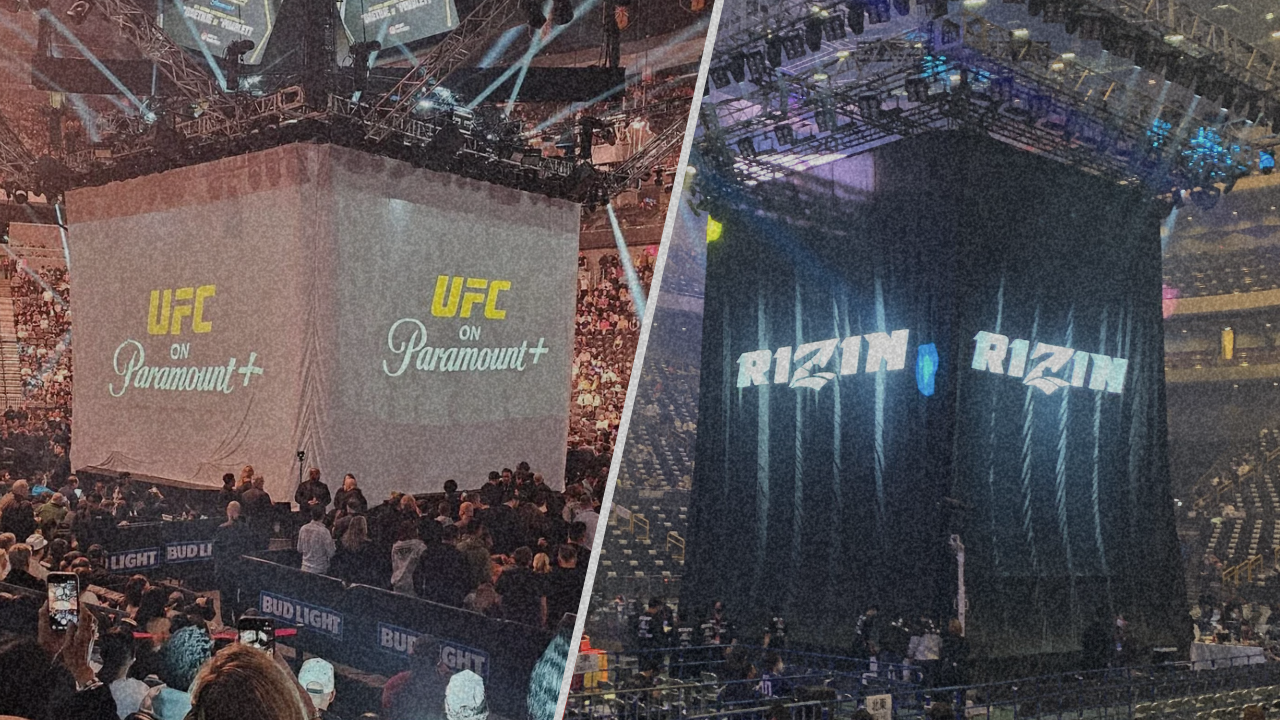
After decades of dismissing Japanese MMA as illegitimate, the UFC now copies its spectacle while preserving a tightly managed corporate order.
There are moments when institutional ideology reveals itself not through statements or policy but through aesthetics. These moments are often unintentional, surfacing when an organization believes it is merely adjusting presentation rather than making an argument. UFC 324 was one such moment.
The broadcast presentation felt immediately out of place relative to the UFC’s long-standing visual identity. The arena lighting emphasized shadow rather than clarity, submerging the crowd in darkness rather than framing them as participants. Entrances were no longer functional but ceremonial, accompanied by pacing and staging that suggested ritual rather than sport. Announcers were elevated and positioned as overseers rather than commentators.
For viewers familiar with Japanese MMA, the resemblance was unmistakable. This was not a subtle influence or a playful reference. The visual language had been directly replicated. The pacing, lighting, and spatial hierarchy closely mirrored that of RIZIN broadcasts and, before that, PRIDE.
The significance of this moment lies not in aesthetics themselves but in what they contradict. For decades, the UFC defined its legitimacy in opposition to precisely this kind of presentation. UFC 324 therefore marked not an evolution but a quiet abandonment of the story the organization once told about itself.
The Story the UFC Told About Itself
The UFC’s rise to dominance was accompanied by a carefully constructed narrative about professionalism and legitimacy. It framed itself as the maturation of a chaotic past, presenting MMA as a regulated sport rather than an uncontrolled spectacle. This framing was essential to securing regulatory approval, broadcast partnerships, and corporate sponsorship.
Japanese MMA, particularly PRIDE, was positioned as the counterexample. It was described as theatrical, excessive, and culturally unserious. Its presentation was treated as evidence of irresponsibility, and its rule set as proof that it could not be trusted within a modern sports framework. The pageantry was not understood as cultural expression but dismissed as spectacle.
By contrast, the UFC presented itself as clean and rational. The octagon was sacred space. Walkouts were minimized. Violence was regulated, quantified, and monetized. This was not merely a stylistic preference but an ideological claim. The UFC did not just offer MMA. It offered the only legitimate version of MMA.
This distinction mattered because it justified consolidation. By defining itself as the adult alternative, the UFC was able to marginalize competing visions of the sport and absorb their audiences without acknowledging their influence.
Late-Stage Empire Logic
When institutions reach total dominance, their relationship to innovation changes. Risk becomes a liability rather than an opportunity. Cultural monopolies no longer generate new forms but instead extract from the margins they once dismissed.
This pattern is visible across industries. Technology firms ridicule early competitors before absorbing their ideas. Media conglomerates suppress alternative voices before repackaging their aesthetics. In each case, dominance produces stagnation, and stagnation produces imitation.
The UFC now occupies this phase. It no longer needs to prove legitimacy. That work is done. What it needs instead is affect, atmosphere, and emotional intensity that cannot be produced through regulation alone.
Rather than openly revisiting the sport’s suppressed histories, the UFC adopts their surface elements. It borrows the look of danger without reintroducing its conditions. This is not homage, which requires acknowledgment. It is extraction performed quietly, without historical reference.
Aesthetic Danger Without Real Risk
The central contradiction of UFC 324 lies in its attempt to evoke danger while eliminating risk. The presentation signals volatility. The lighting, staging, and pacing suggest a space where anything might happen. Fighters are framed as mythic figures rather than employees within a corporate structure.
The rules, however, tell a different story. Soccer kicks remain banned. Knees to the head of a grounded opponent remain prohibited. Any mechanism that introduces genuine unpredictability into outcomes is excluded.
These exclusions are not moral judgments. They are economic ones. Real chaos threatens advertisers, insurers, and betting markets that rely on stability and predictability. A sport tied to multibillion-dollar broadcast deals cannot tolerate outcomes that feel uncontrollable.
The solution is simulation. The UFC presents the aesthetics of danger while enforcing rules designed to neutralize it. Violence is permitted only within parameters that preserve liquidity and brand safety.
What results is not authenticity but performance. The appearance of risk without its consequences. A sport that gestures toward danger while structurally forbidding it.
Fighters as Part of the Theater
Fighters are incorporated into this contradiction rather than excluded from it. They are encouraged to present themselves as rebels and throwbacks to a more dangerous era. Interviews routinely include discussion of rule changes and lost traditions.
The UFC allows this discourse precisely because it is safe. Advocacy functions as content, not leverage. It sustains the illusion of debate without threatening the structure that produces profits.
Material power remains entirely centralized. Contracts are one-sided. Fighters lack collective bargaining strength. Career longevity is uncertain, and replacement is always available. Within this framework, real instability is unacceptable.
The organization permits speech while prohibiting unpredictability. Fighters may talk about chaos, but they cannot introduce it. The line between expression and power is carefully maintained.
What RIZIN Still Understands
This is not an argument that RIZIN represents a purer or morally superior alternative. It does not. It operates within its own constraints and contradictions. What it preserves, however, is an understanding of what makes MMA compelling.
RIZIN allows the sport to feel unstable. It accepts emotional volatility and the possibility of disorder. The tension generated by this instability is not incidental. It is central to the appeal.
When Sakuraba notes that the UFC relies on fighters and ideas shaped in RIZIN, he is describing a structural reality. The UFC benefits from a lineage it attempted to erase. Fighters trained in environments that tolerated risk carry that sensibility into a system that cannot recreate it organically.
RIZIN does not need to claim invention. It recognizes continuity. The UFC, by contrast, must suppress history to maintain its narrative.
The Failure to Bury PRIDE
The UFC attempted to erase PRIDE through acquisition rather than integration. It absorbed the brand while discouraging acknowledgment of its influence. The goal was to control history rather than reconcile with it.
This effort failed. The fighters carried the legacy forward. The aesthetics survived in memory. The ideas persisted.
Now the UFC finds itself quietly reappropriating what it once dismissed. It does so without acknowledgment, presenting borrowed elements as internal innovation. The behavior resembles that of a technology firm announcing features long present in competing products.
This is not evolution. It is historical amnesia paired with imitation.
The Hollow Spectacle
UFC 324 felt hollow because it revealed this contradiction too clearly. The presentation gestured towards the spirit of MMA that the organization has systematically eliminated.
Authenticity cannot be restored through lighting. Danger cannot be resurrected while its mechanisms remain banned. Dressing the octagon in borrowed aesthetics does not revive the conditions that produced them.
The UFC does not lack resources. It lacks tolerance for instability. In a system this large, real risk is incompatible with profit.
So atmosphere is smuggled in without substance. History is referenced without acknowledgment. The result is spectacle without consequence.
Longtime viewers recognize the absence intuitively. Spectacle divorced from risk is not authenticity. It is branding.
And branding, regardless of presentation, cannot substitute for what was deliberately removed.